Showing posts with label avian. Show all posts

Thursday, May 21, 2015

Great Blue Heron

Great Blue Heron (Ardea herodias)

The other day, while I was photographing the Osprey nest, I think this guy got a bit jealous or maybe he was just curious. He came right over to me and hung around very close as if to say, "photograph me; I want to be famous, too". It was a great opportunity to oblige him, don't you think?

Great Blue Herons can be found all over the United States; anywhere water is; they are not fussy, they like both salt and fresh water. They are tall, stately birds that move slowly and deliberately when stalking their prey. When they decide the time is right, they strike with lightning speed. They are similar to cats on a hunt. The Great Blue Heron's diet consist mainly of fish, but they'll eat anything, snakes, lizards, rodents, other birds and small mammals.

Great Blue Herons hunt alone and it is rare to see more than one of them in the same place. However, they nest in colonies. There may be as many as 100 nests in one tree. They are monogamous during a season, but find new mates every year. 

These birds are very long (38-55 inches) with a wing span of 66-79 inches. Despite their size, they only weigh about 5 or 6 pounds, due to hollow bones that enable them to fly.

Monday, May 11, 2015

Ospreys Nesting

Ospreys Nesting

I posted a photo of this family on April 26, if you want to see how much they've grown. I believe the one on the left is one of the chicks and the parents are in the middle and on the right. They only thing that leads me to believe that this is the chick is the one on the left has yellow eyes, while the other two have orange eyes. In the other post, there were 2 chicks and they were both still fuzzy at the time. Now this chick is nearly the same size as his/her parents. I have no idea where the other one is, maybe it's fledged???

Ospreys (Pandion halliaetus) are raptors in the Hawk and Eagle family. They are rather large birds with a wing span of 5ft, 6in and they are 23 inches in length from tail to head. The dark line through their eye is a  good identifying factor. They hover just before they dive for a fish and can be seen flying with the fish head first in their talons, once they catch their fish.

They are resident year long in Florida and can be found near any body of water where they can fish for food. Their diet consists almost exclusively of fish.

Thursday, April 30, 2015

Roseate Spoonbill

Roseate Spoonbill (Aijai aijai)

The Roseate Spoonbill (Ajaia ajaia) is a tall bird, about 32 inches in height and a wingspan of 5ft 6 in, with a flat, bluish bill flattened at the tip.

They get their name for how they feed. They use their beak, swiping it back and forth in the water, sort of spooning for their food. Spoonbills feed on small fish, snail, aquatic insects, and shrimp.

They can be found in mangroves and saltwater lagoons or marshes in the shallower water.  They are resident in Louisianna, Florida, occassionally in Texas, and in the American tropics. 

Because of their color, tourists to Florida often mistake them for Flamingos.

Wednesday, April 29, 2015

Great Blue Heron

Great Blue Heron (Ardea herodios)

The Great Blue Heron (Ardea herodios) is a very large, tall bird. It stands at around 4 ft tall, and has a wing span of 6 ft. The adult's plumage is a blue-gray, with black shoulder patches and a black stripe from his eye to the back of the head.

Great Blue Herons can be found all over the United States and the Caribbean and South America. They are resident year 'round in Florida, and most have lost their fear of humans. Great Blue Herons can be seen near fishermen, standing within a few feet of them waiting to steal their catches. They can also be seen (like this one) walking around on lawns, waiting for a handout.

It is illegal to feed wildlife in Florida, but many people do, which encourages them to come right up to the door waiting for a snack. Snowbirds (people who winter in Florida) feed the birds, then when they leave to go back up North, the birds sit and wait for them to come back (like this one) instead of hunting for their own food.

In St Petersburg, around The Pier, people have fed the Pelicans so much, that they no longer fish for their food and many were starving to death. They City now feeds  them daily to keep them from starving. It's very sad. This is why it is illegal in this state. People who are feeding these beautiful birds are also not giving them natural food that is in their diet, which is making them unhealthy and threatening the species.

Sunday, April 26, 2015

Osprey Feeding Chicks

Osprey Feeding Chicks

It's that time of year again; the Osprey are nesting. Almost everywhere you go in Florida you'll see Osprey nests, especially along the I-4 corridor. This particular nest is in Bradenton, FL where my friend lives. This pair of Osprey have been nesting here for the past 4 or 5 years. Two of this year's clutch is shown in the photo. they're finally big enough to see over the nest.

Ospreys (Pandion halliaetus) are raptors in the Hawk and Eagle family. They are rather large birds with a wing span of 5ft, 6in and they are 23 inches in length from tail to head. The dark line through their eye is a  good identifying factor. They hover just before they dive for a fish and can be seen flying with the fish head first in their talons, once they catch their fish.

They are resident year long in Florida and can be found near any body of water where they can fish for food. Their diet consists almost exclusively of fish.

Thursday, April 16, 2015

Double-crested Cormorant

Double-crested Cormorant
Double-crested Cormorants (Phalacrocorax auitus) grow to about 33 inches. Immature Cormorants, unlike the all black adults are brownish, with whitish plumage from the throat to the breast. 

Cormorants swim with their bills angled upward. Flocks often fly in a V formation. They can often be seen resting with their wings open drying. They nest in colonies in Cypress trees and Mangroves.

They live on the coasts and near large bodies of inland water. Florida has a resident breeding population and there are numerous migrants from northern U.S. from November through April.

This image was taken at Crescent Lake Park in St Petersburg, FL.

Friday, January 23, 2015

Wood Stork

Wood Stork
This Wood Stork was probing for dinner in the pond at the Thompson Sports Complex Park, in Gulfport, FL. The Wood Stork is the only real stork we have in the United States.

Wood Storks stand between 40-44" tall. Their heads are bare. They fly with their necks extended. Wood Storks can be found on or near the coast, cypress swamps and mangroves. They nest in colonies. Wood Storks are resident in Florida and Georgia and rarely along the coast from S Carolina to Texas.

Wednesday, January 14, 2015

Brown Pelican

Brown Pelican

I went to my friend's house in Bradenton, FL yesterday looking for White Pelicans. Unfortunately, I wasn't able to find any, but I did manage to shoot this Brown Pelican. This guy was very cooperative. It actually was pretty easy because I was on a pier where a fisherman was cleaning his fish. This one was just waiting around for a handout, so I was only a few feet from him.

Brown Pelicans have brown heads in the Summer and are all white in the Winter. They feed on fish, alone or in groups. They make spectacular dives, flipping from their backs just as they hit the water, then going in bill first. They swallow huge fish and you can see it wiggling while they're trying to swallow it while it's still in its pouch.

Brown Pelicans nest in colonies in trees or on mangrove islands. They are resident in Florida and are very common near the ocean, bays, estuaries, and a few wander inland.

Sunday, January 11, 2015

Tricolor Heron

Tricolor Heron

This was shot 3 days ago at Sawgrass Lake Park in St Petersburg, FL. He was just wading around looking for dinner in the shallow water.

I'm always excited when I spot Tricolors. There are plenty Great White Egrets and Great Blue Herons around because they've lost their fear of humans, but I don't see as many of these guys. I'm not saying they're rare, they seem to be more secretive and shy than the others. Green Herons and Reddish Egrets are also pretty elusive.

This one didn't pay much attention to me. He was too intent on hunting. I was lucky to be able to get this shot.

Thursday, January 8, 2015

Boat-tailed Grackle

Boat-tailed Grackles are very common in St Petersburg, FL. We have 2 species here, this one and the Common Grackle. The Boat-tailed Grackle  is much larger, up to 16 inches, while the common Grackle is about 12 inches. They hang in marshes and along the coast. They can also be found on farmlands.

Sunday, January 4, 2015

White Ibis

White Ibis

This curious White Ibis came within a ft of me at Lion Country Safari in Loxahatchee, FL. These birds can be found all over Florida usually in flocks on people's lawns probing for insects. According to a landscaper friend of mine, the probing is actually good for your grass; they are aerating it and keeping the insects down. They can also be found near the shore or on the banks of fresh water looking for small fish, crustaceans, with crayfish being one of their favorite foods.

Males and females look similar, but the male has a longer beak and is slightly larger than the female. Juveniles are brown and white and during breeding, the adult's beak and lores are deep red. Their wing tips are black, which can be seen in flight, but normally when they're on the ground the black tips are tucked under the white plumage. Ibis are both beautiful and friendly.

Tuesday, December 23, 2014

White Ibis

White Ibis

I have to admit, I've been a bit lazy the last few days. I haven't been out shooting for whatever reason; tired, lazy, unmotivated, call it whatever you will. I just haven't been out!

This image of the White Ibis was shot last month at Sawgrass Lake Park. I don't know why I never noticed how much I liked his reflection in the water. I'm still not sure I like that feather and its reflection between them in the background, but at the last minute decided to leave it in.

I captured this image with my Canon 6D, 28-300mm Tamron lens (my favorite walk-around lens), handheld at f13 and 1/40th, racked all the way out to 300mm, ISO 1250 in Aperture Priority mode at -1EV, and Center-weighted average metering, in the late afternoon. I can't believe the VC (vibration compensation) on this lens allowed me to shoot this hand-held at 1/40th and 300mm. This lens is just amazing. It's light, easy to carry around my neck on my 6D all day. I just love this combo.

Tell me what you all think of that feather. Is it too distracting?

Wednesday, December 3, 2014

Red-shouldered Hawk

Red-shouldered Hawk

My favorite nature park used to be Boyd Hill Nature Park in St Petersburg, FL. I haven't been there in 14 years. I had moved further away, and I guess I just forgot about it. Now that I've moved closer again to the park, I decided to give it another visit late this afternoon.

This is one of my favorite shots from today's shoot. This guy is a Red-Shouldered Hawk (Buteo lineatus). They are plentiful in this area, but not nearly as plentiful as Ospreys. Ospreys are everywhere. Red-shouldered Hawks are medium sized hawks. They are called Red-shouldered because of that reddish patch on their shoulders.

These hawks eat mice, frogs and snakes, so can be seen in woods with tall timbers and water. They hunt both from the air and from high perches. They can be found in the Southeast year round.

Monday, December 1, 2014

Great Blue Heron Up Close

Great Blue Heron
The other day during my trek to Spa Beach, I spotted this Great Blue Heron perching on a wall near a fisherman, just waiting to grab his fish.

These guys are the best at stealing a catch. The poor fishermen do all the work, while the Great Blue Herons, Great Egrets and Pelicans hang around just waiting for them to reel in their catch. As soon as the fish is above water, the bird swoops down and steals it.

Herons, Egrets and Pelicans in this area are so used to people they have lost all their fear of humans. It is not unusual to see 4 or 5 birds within 2 feet of fishermen. The fishermen try to chase them away, but all they do is move another 2 feet or to the other side of them and it all starts over again.

It's pretty comical to watch; that is, if you're not a fisherman. They don't enjoy these birds at all.

Tuesday, November 25, 2014

Brown Pelican

Brown Pelican in Flight

Another rainy day today and more scheduled for tomorrow. So much for shooting for my bird's eye view self-assignment.

This was shot yesterday over Spa Beach on the roadway to The Pier in St Petersburg, FL. He was just about to dive for a fish. I love the graceful way Pelican's fly, especially when they hover over the water looking for fish. Unfortunately, this guy wasn't doing that. He was using his own bird's eye view from the air.

Monday, November 24, 2014

Great Blue Heron

Great Blue Heron
Today, my self-assignment was bird's eye view. Unfortunately, we had a lot of sea fog, and a high up level was shrouded in fog. So, instead I went out just looking for something to shoot.

I went to a park I haven't been to in years only to find out it was closed on Mondays. Then I went to another park and found nothing interesting there, so I went to The Pier. Although the building is closed, the roadway on the way to The Pier is still open.

I spotted this Great Blue Heron on the top of a roof on the walkway in one of the decorative shelters (it's the only thing I can think of to call this thing). He was just standing there looking out over the water. It was difficult shooting up in the air, but out of several I took, I like this one. I like the blue sky for a background and I like his stance.

It's still the same old stuff I've been posting for so long, but this time, I took my time and looked for a good background, taking care not to have any other distractions in the photo so I wouldn't have to crop anything out.

Friday, November 14, 2014

White Ibis (Eudocimus albus)

White Ibis (Eudocimus albus)

This White Ibis is only one of a flock of maybe 25 who decided to visit me on the edge of the little pond at Thompson Sports Complex Park in Gulfport, FL.

They can be found in the deep south and are very common in the Tampa Bay area. They are friendly birds and will rarely fly off if a human comes around. In this case, it was exactly the opposite. The moment I appeared, these guys decided to join me. It was difficult to get one alone. This guy was only a few feet from me, making it very easy to get this capture.

They eat insects and continuously probe the grass and the water looking for food. They are fairly large birds at 22-26 inches tall. They weigh about 2 1/2 lbs. These birds are social and nest in trees at night.

Thursday, November 13, 2014

Please Help With ID

ID Wanted

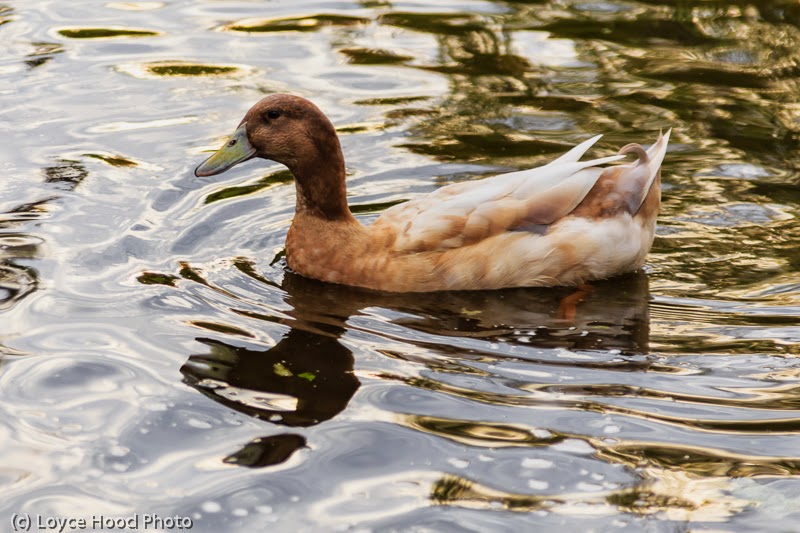
I've posted photos of this duck and his/her mate about a year ago. I'm still trying to find out what kind of duck this is. With all the nature photographers out there, I can't believe no one knows what it is called. I've only found one other photo of ducks that look like this through Google and I think it was the same pair. Whoever posted it didn't include the name, so it was no help.

They are so pretty. They hang on a little pond in Gulfport, FL along with some Mottled Ducks, White Ibis, a pure white duck, a few Mallards and a couple of Moorhens. There is only 1 pair of them. They are much larger and longer-backed than Mallards as you can see in this photo.

Your help is greatly appreciated. Thanks for looking.

Thursday, November 6, 2014

Black and White Challenge Day #1

Snowy Egret

My friend, Rosemary, challenged me to post 1 black and white photo per day for 5 days. I'm also supposed to challenge another photographer that inspires me each day to do likewise. This is my 1st day post.

I shot this today on the way home from work under the Sunshine Skyway Bridge in St Pete at the South Rest Stop. You can go through this entire blog and I doubt you'll find any black and white shots. I guess after college, when I had to do black and white, I wanted so badly to shoot color. I've never stopped. This is going to be challenging.

I challenged my Facebook and Flickr friend, Nicholas Light Bandit Ong from Singapore today. I'm anxious to see if he takes the challenge.

Sunday, October 5, 2014

Yellow-crowned Night Heron

Yellow-crowned Night Heron


This Yellow-crowned Night Heron was just posing there at Largo Nature Park waiting to be photographed. There were three or four of us just snapping away and he didn't move a bit.

Several people from one of my Meetup groups were going to a shoot at this park, and since I haven't shot any nature photos with my new camera and lens, I thought I'd tag along. It was lucky that we came upon this usually very skittish bird.

We had a great time with the exception of the Mosquitoes. None of us thought to bring bug spray. Well, I had some in the car, but didn't want to loose track of the crowd and it was a long walk back. It was kind of foolish that we didn't think of it, especially when we all knew that the area was flooded. Tampa Bay had 2 weeks of bad weather and the ground is soaked. That'll teach us!