Showing posts with label waterfowl. Show all posts

Saturday, April 18, 2015

Domestic Swan Goose

Domestic Swan Goose (Anser cygnoides) with Ducklings/Gooselings?

I'm very curious about what's going on here. I know ducks, geese, and swans sometimes interbreed, but do they do it within the same species, or do they interbreed with any other close species? This photo, taken at Crescent Lake Park in St Petersburg, FL, has me very confused. This goose appears to be swimming with ducks, as you can see, some are white, some look like immature mallards. Are they hers? Do they just hang around together?

This lake supports so many species. There are Domestic Graylag Geese, these Domestic Swan Geese, Mallards, Moorhens, Grebes, American Coots, just to name some of the waterfowl. There are probably more than I spotted on my two trips there as well. I'm just curious about how some of these breeds got there and if they all interbreed. If you live in the area, check it out.

Here is a little info gleaned from the internet about the Domestic Swan Goose:
Domestic Swan Goose (Anser cygnoides)

Another species of goose that has been domesticated is the Swan Goose, native to eastern Eurasia and sometimes called a Chinese goose. A domestic swan goose usually has a large knob at the base of the bill (the wild form lacks this). It also can show a white patch behind the bill.  It varies from wild type coloring (mostly gray with a dark line down the back of the otherwise white neck) to pure white.


Swan GooseThe Swan Geese (Anser cygnoides) -- also known as Chinese Geese - are rare, migratory geese that breed in inland Mongolia, northernmost China, and southeastern Russia; and most migrate to central and eastern China for the winter.

Vagrants travel to Japan and Korea for the winter and, on rare occasions, may winter in Kazakhstan, Laos, coastal Siberia, Taiwan, Thailand and Uzbekistan.

Outside the breeding season, they form small flocks. They rarely swim and often forage far from the water.

The large Swan Geese have also been introduced to countries outside their natural range, where feral populations of escaped or released domesticated birds have established themselves.

Thursday, November 13, 2014

Please Help With ID

ID Wanted

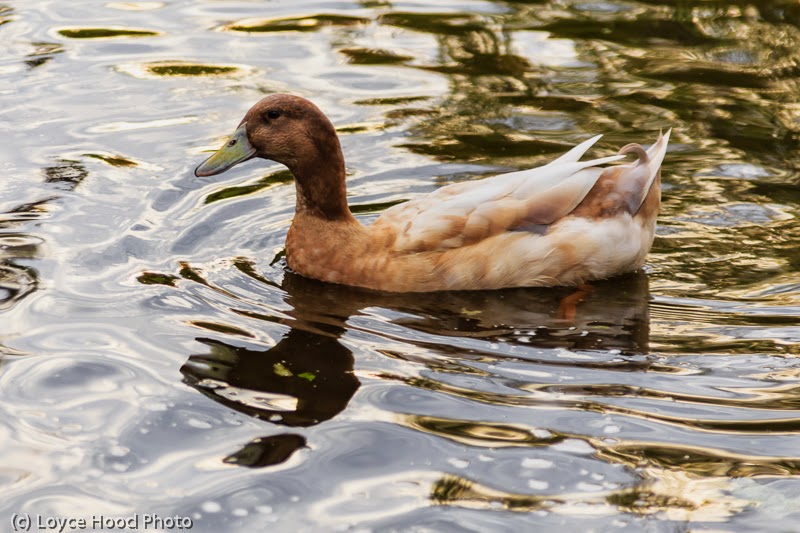
I've posted photos of this duck and his/her mate about a year ago. I'm still trying to find out what kind of duck this is. With all the nature photographers out there, I can't believe no one knows what it is called. I've only found one other photo of ducks that look like this through Google and I think it was the same pair. Whoever posted it didn't include the name, so it was no help.

They are so pretty. They hang on a little pond in Gulfport, FL along with some Mottled Ducks, White Ibis, a pure white duck, a few Mallards and a couple of Moorhens. There is only 1 pair of them. They are much larger and longer-backed than Mallards as you can see in this photo.

Your help is greatly appreciated. Thanks for looking.

Monday, February 25, 2008

Wood Duck Couple


About a week ago, my friend, Kathy, who belongs to my Meetup Group (Florida State Photography Meetup Group), and I went to Lowrey Park Zoo in Tampa for the afternoon.

There were so many things to capture there, I could've stayed a lot longer, but, we had to get home before rush hour.

Kathy and I are both passionate about photographing nature. This pair of Wood Ducks (Aix sponsa) can be found anywhere from Brittish Columbia south to CA, and from Montana east to Nova Scotia and south to TX and Florida. They are absent in the Great Plains and Rocky Mountains. They winter near the Pacific Coast north to Washington, and to New Jersey in the East. They rarely go further north.

Their habitat is in wooded rivers and ponds, wooded swamps and they visit freshwater marshes in late summer and fall. They nest in cavities, which enable them to breed in areas lacking suitable ground cover. The young leave the nest soon after hatching, jumping from the nesting cavity to the ground or water. Once out of the nest, they travel through wooded ponds with their mother. Snapping turtles take a heavy toll of the young.

I was thrilled to capture this couple. This is the time of year that they form pairs and begin to look for nesting sites.

Sunday, December 16, 2007

Muscovy Duck

These friendly ducks are either hated or loved. Personally, I love them. They're friendly, quiet and not the least bit afraid of people.

There are some people in my neighborhood that would love to see them go away. Right now, the town is trying to pass a law to prevent people from feeding them and all other birds. This is ridiculous! I hope the law isn't passed.

This one is on the bank in my back yard. We have several families living here and I enjoy seeing them. In the spring, after their chicks were hatched, they brought them into the yard right up to me to show off their little chick. They were so cute. I'd really miss them if they were to go away.

Muscovies are fairly large birds and can grow up to 20 pounds. They originally came from Mexico and are a tropical bird. However, they've adapted to the climate in the United States and have been found living up north.